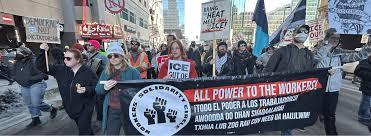
The labor movement has been on the decline for decades in the United States. Union membership has steadily declined since the 70’s. Union membership is down from 20.1% in 1983 to about 10% according to recent data. This gives workers zero space to advocate for themselves, their coworkers, and the working class more broadly. Such low union membership puts the working class in a weak position to take on the current onslaught of fascist attacks, let alone tackle abolishing capitalism. Workers Solidarity Circle, is a response and support to a working class that has lost its militancy.
For the small percentage of workers who do belong to unions, those unions are, more often than not, defanged institutions that rarely push militancy in the workplace, while failing to put forward bold visions of societal transformation. Labor militants and anti capitalists in the Twin Cities have zoned in on this situation. In doing so, we have joined a growing movement of workers across the country that see the importance of a bold labor movement that can not only take on and defeat fascism, but also transform society into one organized and led by the working class. We founded the Workers Solidarity Circle (WSC) to do just that.
The Workers Solidarity Circle is an anti-capitalist, antiauthoritarian formation founded by various organizations seeking to build worker militancy and worker power. We believe that:
-The Working Class and the Employing Class have Nothing in Common: we seek to win through our own power not partnership with the bosses.
-An injury to one is an injury to all: solidarity and unity among workers against racism, sexism, homophobia, transphobia, and disability is how we all win liberation for all from our oppressors and the oppressive system that serves them to our immiseration.
-Nothing about us without us: through debate, open discussion, and democratic decision making in our unions and industries we will lead our own liberation.
-Direct Action gets the goods: workers using collective action through marches on the boss, walkouts, and strikes is how we both train ourselves as worker militants and make decisive victories that build the power of working people.
-We only want the world: we need more than piece meal reforms. We need and seek to build a society under democratic worker control that ends exploitation in our schools, workplaces, and communities once and for all. This is the ultimate goal that guides our work.
We hold fast to these principles and see our organization and framework as significant in the fight for the liberation of the working class.
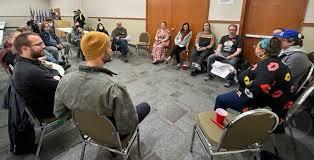
The WSC birthed our workers assemblies. The goal of the workers’ assemblies and WSC more broadly, is to create solidarity and mutual aid with workers in struggle, whether it be strike support, union drives, fights on the shop floor, fundraisers for workers struggles, or rapid response to retaliation. In a free society, workers assemblies alongside neighborhood assemblies would be the place where workers decide not only the conditions of their industry but how those industries operate to meet the needs of the community. This should be done in ways that are in ecological harmony with the landbase we depend upon for survival. The dream of the assemblies is to prefigure a society under democratic worker control while taking on this current wave of fascist assaults on our communities.
We hold direct action, political education/cultivation, worker democracy, and agitation/propaganda as core aspects of our work. We engage in direct action through event-support campaigns, direct action against bosses and fascists, and workplace delegations. Political education and training are key as well. This is rooted in immigration defense, strike prep, antifascist defense, contract campaigns, tenant struggles, and climate organizing. More broadly, we advocate and fight for democratic processes within unions and workers’ organizations. The broad goal of political education is to foster broader worker militancy in the labor movement and workers struggles over all. Education and propaganda are encouraged through social media and worker centered newsletters, posters, memes, and other forms of media that reach everyday workers and proliferate worker militancy.
The assembly is also a place to foster ongoing debate and strategy within the WSC and across the labor movement as a whole. The assembly is at its core a place for all workers to develop as leaders and organizers.
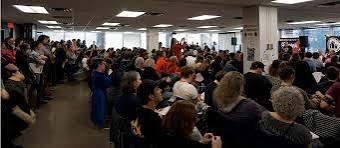
Our most notable Workers Assembly had over 400 workers from 30 unions to debate proposals geared toward taking on the Trump administration and the “Operation Metro Surge” attack on immigrant communities in Minnesota.
Deportations in our city were resisted by not just self-described anarchists, socialists, and communists but by everyday working people. For example, outside schools you would see parents in yellow vests keeping watch to make sure students got to and from school safely. My union, Minneapolis Federation of Educators, advocated for and worked with Minneapolis Public Schools to bring about online learning for students who felt unsafe due to ICE activity in Minneapolis. On January 23rd, 2026 thousands of workers across the Twin Cities refused to go to work or shop in resistance to Metro Surge, making it the boldest coordinated labor action in the United States in nearly a century.
Within capitalist society, people have little power to shape and make changes through established government structures. We elect people and they act with little to no accountability to the populace they are supposed to represent. Within the workplace, there isn't even the pretence that there is or should be democracy. Workers have little power to shape the conditions of their workplaces and industries.
Spreading the Workers Assembly model has great potential to transform the labor movement nationally and deepen the tradition of direct democracy across the country.. In the majority of the country, union density is low, making the establishment of worker centered democratic structures paramount. Having a space to strategize militancy and advancing worker power nationwide is central to creating a stronger, fighting labor movement.
In Minneapolis, the founders of the workers assemblies have the benefit of working in a city and state with an established and strong labor movement compared to the majority of the country. For us, our fundamental concern is strengthening our movement by training workers to take more control of their unions with deepened democracy and support in unionization efforts. Many of us in the Black Cat Workers Collective have spent over a decade working together in not just labor, but movements around police terrorism and antifascism as well.We have all worked to bridge the gulf between labor and other areas where the working class is under attack. These understandings formed the foundation of our philosophy and approach to militant labor struggle and our work within Black Cat and WSC. This philosophy and approach connect the local labor movement to protecting abortion access, antiimperialism, and resisting ICE attacks on our immigrant neighbors and coworkers. This militant, social justice unionism approach,we argue, is central to the success of our work.
The Workers Assemblies played a key role in labor’s response to Metro Surge in the Twin Cities. In Black Cat’s report on this, titled, “We Keep Us Safe: Horizontalism, Repression, and How We Win Against ICE” we had this to say about the impact of the assemblies:
The labor movement must become more democratic. Workers throughout the country must be able to leverage their labor towards their own liberation. The Workers' Assemblies in Minneapolis represented a shift in power and purpose within some unions. At these assemblies people discussed, deliberated, and voted on the actions and ways to move their coworkers toward said action. Americans spend more time at work than almost anywhere else except in bed. These workplaces become communities of their own.
The Worker's Assemblies exemplified direct democracy within the labor sector. The assemblies contained myriad perspectives. Thoughtful debate and deliberation formed powerful ideas for action. Patient attendees worked through details and minutiae to ensure the most effective tactics were used. Workers of every experience level spoke. No one was ignored without consideration. No leader coerced decisions or threatened those with opposing ideas. The assemblies were novel and beautiful. They showed us that direct democracy is effective. They showed the rank-and-file of the Twin Cities that we can effect change.
By submitting and debating proposals in regards to how to respond as a labor movement to the ICE occupation, hundreds of workers experienced first hand a level of direct democracy that far too few get to experience in this country.
This groundswell of organizing is exactly why the federal government is going after the Minnesota 15, many of whom are labor organizers and union members; many are shapers of the WSC and the Workers Assembly. The state fears us because we are bringing the power of the labor movement to social struggles in ways that activate everyday people to fight back. There is great concern by the federal government about the role of the labor movement and anarchists in resisting the Trump administration. Black Cat and the Workers Solidarity Circle are explicitly mentioned as organizations of interests and the Workers Assemblies themselves were infiltrated and monitored.
Moving forward, the Workers Assemblies will continue at the end of October, with that session focusing on austerity and state repression like that being experienced by the Minnesota 15 and the Righteous 39 against ICE. The state fears that we are not only building a movement that can combat the kidnapping of our neighbors and coworkers, but also a movement that can take on austerity in the public sector, such as education and healthcare. We will face this repression with perseverance and courage in our work. Our fight is far from over and democratic workers assemblies are exactly the structures we need to decide collectively how to struggle and ultimately win together.